
$21,000. It could buy you a car, it could be a down payment on a house, you could take off on a couple of amazing vacations, have a really nice wedding, or it could pay for your sick mom’s liver surgery. Better yet, how about 3 meters of speaker cable?
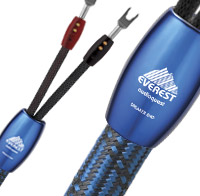
The crazies wonderful people people at Audioquest are selling this new speaker cable called the Audioquest Everest . This audiophile speaker cable boasts “Counter Spiralling Geometry” and “Spread Spectrum Technology” conductors. It’s got 4 different sizes of positive conductors and eight (!) negative conductors.
They of course claim that it “provides considerably better transparency and dynamics” and that the “Pure Perfect-Surface eliminates harshness and greatly increases clarity”.
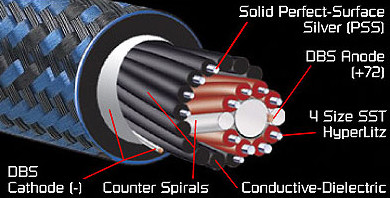
Now, I realize that I just posted about the $5000 ipod earphones , but hey at least those are a fashion statement. These audiophile cables aren’t diamond-encrusted! I always thought that the Pear cables were ridiculously expensive at $5000, but obviously they are tinny & distorted compared to these babies.
I remember once James Randi did a double blind test with Pear cables, comparing them against regular electrical cable (yes, the type that you plug into your coffee maker). James, are you listening? I need you here! Maybe you could tell a difference if you used this on your CD’s first.
If you’re ever wondering if expensive cables are snakeoil, then check this or this out.
Mom, forget that liver operation – i REALLY need my Counter Spiralling Geometry audiophile speaker cables when I listen to my favorite music.
I say maybe just save your money and use some coat hanger wire.





This sort of stuff makes audiophiles look like crazies. Here is a comparison of a DIY cable and an expensive one.
http://diyaudioprojects.com/Power/DIY-Braided-Speaker-Cables/
LOL, amazing! As long as their are rich people in the world, their will be things for them to throw their money away on!
Jess
And most people suffer from some degree of tinnitus anyway, so this cable is useless.
@ gio
LOL – nice link, man. Made me laugh
Remember what PT Barnum said?
Cable is cable. All you really have to make sure of is that your grounds are solid and that you don’t have an unbalanced line. Everything else is just the cherry on top.
But to paraphrase Barnum, “There is one born ever minute.”
No, this cable is useless anyway.
Once saw an article about a double blind test using monster cable and coat hanger wire. Couldn’t tell the difference. In fact, some said that the coat hanger wire sounded better!
It’s a good con…
i think you better look to Nordost Odin of you want something more expensive than this :p in fact, there’s a few that top out this guy price-wise.
I actually think this will make be best clothes line yet. Surely all the shirts will dry quicker and come off wrinkle free as well.
Oh… and one more thing. How many of you have experimented with cabling in your own system? and how bad is your system… really? Lots of people looooove talking about things they don’t have a lot of experience with, and audio cables are especially succeptible. I once spent 2 years working in an audio store to put together a system. guess what? I decided that i should get about 11 thousand dollars worth of cabling. The cabling, costly as it was, made a more significant improvement in the sound than spending say 10k on any other components, or spread over them, in any way. You should give it a try some time. Take 2 years if you need to. Just don’t talk about it like you are “smarter” than people who actually take the time to see and laugh when your ears have no experience with it.
ANODE and CATHODE – such trendy-sounding words marked on this cable ….last time I looked speaker audio is Alternating Current. Audiophools !
@Nik: you said the magic no-no words: Monster Cable. Monster is overpriced, and really isn’t better than a coat hangar :p Although i’d like to know the associated equipment before making a judgement. I have heard, for example, a 7 thousand dollar cable make a system sound pretty lousy compared to something much cheaper. It’s not as simple as good/bad. System synergy becomes more and more important as price tags go up.
Reminds me of cable used for the old rabbit ears antenna.
“ANODE and CATHODE – such trendy-sounding words marked on this cable ….last time I looked speaker audio is Alternating Current. Audiophools !”
Foolish man, of course you need to know the polarity or you’ll get lovely out of phase stereo speakers.
arent these cables made for recording studios?
anyone who buys shit like this deserves to be shot and have their money spread around to the poor. thank you!
aa added these pithy words: “arent these cables made for recording studios?”
Absolutely not! NO recording engineer would be stupid enough to waste money on this kind of fraud! Check any recording studio (or any pro audio setup) in the world, they are using conventional products like Belden and Canare. A proper 10 foot speaker cable should cost no more than $25, plus Speakons or banana plugs, whatever.
this isn’t fraud… like i said, i spent 2 years working in a shop listening to the differences cables make all day, and i was convinced enough to buy things that cost more than the majority of people’s entire audio system. If any of you want a demo and you live in calgary let me know. I think you need to be hearing things before you all go completely crazy about this. It frustrates me to see so much ignorance on cables.
What’s worse than an audiophile? A rich audiophile.
I will say that there is a considerable difference in the quality of Mogami cables to anything else.
I built my own Mogami cables with Neumann connectors, and there is a distinct difference, when compared to something like a Monster cable. Mogami cabling is very good at transmitting mid-high range, and articulations are much more clear. Whether it’s a speaker cable, XLR, TT, or TRS, Mogami is definitely the way to go.
However, I’d love to try these out, as I strongly believe (not even believe, I can HEAR the difference) in good cables vs. any other crap.
The way a cable is shielded, and coiled makes a huge difference. From the description of these, they might be good. Unfortunately, since most of what I engineer for people ends up as an MP3 coming through crappy iPod headphones, or MacBook speakers, I don’t think it matters to anyone but the audiophile.
If you can notice a difference that justifies the price, then fine. But I don’t think there is any aspect of sound quality that is worth a $21k cable. I would honestly like to speak to someone who could endorse this with a straight face, and somehow justify the price.
It’s the only cord I’ll use in my studio.
I’m sorry, folks, but any of you who said unequivocally that the speaker cables did not offer an improvement over your lamp cord you’re currently using or that they weren’t worth what they’re asking are dead wrong.
Audiophiles traffic in goodies that you have no background in. I worked in the high end audio market for over 6 years and I heard some music reproduced that I would defy to you to pick out from a LIVE performance in a blind listening test. The system? Speakers – $30,000/pr. Wilson Watt Puppies, amplifiers – (2 for each speaker) Mark Krell 500-watt monoblock single channel amplifiers at $7,000 apiece, source – VINYL! That’s right, kids – records. It’s recorded and manufactured as an analog process and that’s what real music is composed of – analog sine waveforms. No digital source including SACD that I heard during my years of being around these folks sounded as good as 180 gram vinyl albums. Turntable? – $15,000. Preamplifer? $22,000. Interconnect cables? Nordost Valhalla model at $4,000 a pair for 1/2 meter lengths. And finally speaker cables – Kimber Kable Select KS 3038 Speaker Cable at $7,500/8 ft. pair.
It’s not that anybody here is stupid, but you are ignorant of what exists our there in high end sound. Unless you truly love music and are driven to its most accurate reproduction, you won’t understand anything about these components.
Pick up any copy of Sterophile Magazine and you’ll see that an entire world of this stuff exists out there. I know I was amazed at the depth and complexity of just exactly what is available.
really? in reality, is this going to afford you any marginally better quality than a 10 gauge 8 core? no.
Hey Schoon, would you like to share with us your listening experience with expensive cables an your associated electronics? I’m very interested to know what you’ve heard, since no one i have ever met who has done listening tests with great gear has ever come to that conclusion. Like i mentioned before, people love to form opinions on things they don’t actually have experience with, i just want to be sure you’re not one of them.
crazy invention
As a musician and an experienced recording engineer and electronics technician, I can assure you that these expensive interconnects, Speaker cables, and especially power cables make absolutely no difference in sound. It is a total placebo effect. If you tell yourself that you can hear a difference, then you will hear a difference…..but the difference is in your head. These companies are selling expensive products to people with more money than brains. The one thing that all of the high-end audiophile companies are experts in is Marketing.
it is for the most part a bunch of crap…however, i once got my hands on some 400 interconnects for a few days. I decided to try an tell a difference.
i bought a pair of $1, heavy(16 gauge in a dollar store interconnect!) dollar store interconnect. I had my friend cover my equipment from view and put on a set. he would leave the room after turning on the cd player. he randomly selected which one he would try next with a graphing calculator random number generator. we did this 40 something times over the course of 1.5-2 hours….i could tell the difference, picking the correct one more than 90% of the time, with very short music samples. he tried it a few days later, with the same setup, same music, it was the same result….
what i dont understand is cables costing more than $400….what are you paying for? if you made a cable out of solid gold it probably would not cost more than 15k….(no idea what it would weigh…just my guess)
this is simply highly refined copper
a funny thing is, the $400 cable was audioquest to…
I guess if you are obsessive enough you will spend anything…
Hey Dad,
that special cable we bought yesterday ?
Yes ?
It’s 3 inches too short !!!
The irony of spending 50k on your stereo system is that the album you’re listening to was probably recorded on 10k worth of equipment.
While many albums were laid down in million dollar studios, the bulk of the world’s recordings have probably been recorded on average equipment.
Any gains in sound quality you may hear on playback, sure as hell weren’t heard during recording and the artists/engineers probably didn’t even care that much.
That is the most incredible point made in any forum ever on discussing the cost of home entertainment! I try and have the best that I can afford, starting with speakers, but am pragmatic and thrifty as well. I was reading somewhere about some $58,000 speaker wires, and thought it would be better to just hire bands to play live.
Your point and logic is exactly what I was looking for, thanks and well said!
All cars go forward, brake, and steer left and right. Yet you will not find any affluent car enthusiasts aspiring to own a toyota corolla. Ask yourself why is this so. They must see or feel something is missing in the driving experience compared to ( insert your favourite expensive car here). Having listened to nothing but upper echelon equipment for the last twenty years or so, I cannot enjoy hearing music through what most would consider “good” equipment and accessories. It just sounds flat, harsh and little better than noise. It is a shame that these consumer products are so costly but I appreciate and applaud the manufactureres for producing them. They are truly works of art and a joy to hear and own for those who can afford them. Someone mentioned recording studios using canare and belden. I won’t disparage these products but they are pure workman cables. Most studios have tight budgets but the most successful of them are coming around and have installed highend equipment and cabling. In the early days of cds most studios were using AD convertors that cost $200. Many recording artists have openly complained about how when they listen to their own recordings at home, just how truly awful they sounded compared to the master tapes ergo many invest in expensive sound equipment even though some have their own studios at home. If coathangers were any good at conducting music to speakers, my clothes would be on the floor!
It is interesting to note that few if any of the postings contains any scientifical reasoning. The audio spectra is close to DC, and there will for example not be any skin effect on the conductor. The current travels through the entire cross section of the material. Only when you start to approach the microwave spectra will the surface of the conductor start to count.
Some inductive attention might be justified to speaker cables, but any such consideration is likely to have very minimal practical impact. Low resistance is the key, little else matters. And BTW, you can measure all these parameters very precisely instead of using your pityful instruments for ears.
To you audiophiles; had you been educated, you would have understood that you should not have cables at all. The theoretical optimum is of course to attach the speakers directly to the terminals of the final transistor outputs (or valve transformer if you are religious enough to beleive in that stuff).
Here’s my suggestion on making even more money on the global ignorance; sell these ridiculous cables as a kit together with a homeopathic treatment that will promise the believer that his ears will suddenly be considerably sharper, all it takes is a year’s treatment with that extremely diluted substance, for which the effective molecule we cannot disclose.
I too use to work in a highend audio shop in Woodland Hills California plus worked with a friend who owned a recording studio in Thousand Oaks California. I compared $500 (sold terminated in 6′ lengths) highend audio speaker cable to $18 (sold by the foot at $1.50 and adding terminators that cost $5 each) midend audio speaker cable of equal lengths of 6′, and isolated from any other wiring that could cause interference. Neither my friend who records professionally nor I who sold the stuff could tell the difference doing an A/B blind test comparison. BUT, then we took a set of cheap copper/aluminum small guage wiring and compared it to the $1.50 wires we used above and we could hear a difference in the base especially but also in clarity. I asked why, so my friend hooked up a volt meter that measured resistence and found the resistence to be higher in the cheap wires vs the $1.50 wires, but the resistence was same when comparing the $1.50 to the $500 wires. The guage of the $500 wire was the same as the $1.50 wire except the $500 stuff used timed phased twisted stranded silver wire (huh?) instead of oxygen free stranded wire.
We did the same test with equal 3′ lengths of audio interconnect cables using $25 midend cable against $1,200 higher end and concluded the same results, no difference. But those results could change if we were running 150′ feet of interconnect cable, but we didn’t test for that.
Our test basically proved that you should use larger gauge wiring the longer your wire run has to be. The same is true with electrical devices, for example my wet/dry vac says that if I run it using a 25′ extension cord I can use a 18 gauge (AWG) cord, but if I use a 150′ cord I need to up that to a 12 gauge (AWG) cord. If I use a cheap 18 gauge 150′ cord then I take a chance of burning my motor out. Your speakers are electrical devices plain and simple, there is nothing magical happening, just electrical current making the voice coils that turn into electromagnets when current is applied do their jobs. Thus the longer your speaker run is the larger the speaker wire gauge has to be to prevent your amp from running hot and maybe burning out just as my wet/dry vac would do.
oddio,
I won’t even tell you who laughed all the way to the bank making this cable for AudioQuest. It would shatter your imaginary world.
Do any of you audiophools also rewire your speakers and associated equipment internally to uphold the level of quality that your precious interconnects and speaker cables reach? Wouldn’t want to bottle-neck them at that point would you? After all, a system is only as good as it’s weakest link…but then again that’s probably either your ears or your room.
I do. My power distribution is internally wired with Nordost Valhalla, and the inside of my speakers were rewired with the same wire that comes from my amps.
Interesting thread…what I find most interesting is the bashing of audiophiles by individuals whom I suspect consider the Bose Lifestyle the epitomy of audio excellence, and have neither the desire (or the money) for anything better. That’s fine, not everyone is interested in audio reproduction…just like I would never buy a $20,000 camera lens when my iPhone works just fine for me.
Speaker wire and interconnects have always been hotly debated, the engineers relying on quantifiable data, the audiophile relying on ears. Reduction theory always falls short, irrespective of scientific desire to quantify everything. An excellent example of this can be seen in Neurobiology, who’s adherents hope to understand behavior and thought processes via fully elucidated neuroanatomical mapping. Regardless if they ever achieve 100% certitude in the laboratory, in the final analysis each individual will still have a unique perspective over the world about them. (which is why Psychology and Neurological Science will always be at odds).
The same holds true for audio gear. I am not listening to graphs, theories, measurements, or meters…I am listening to music with MY ears, which are subject to the biases of my particular predilictions. (in my case, watching movies on a 7.3 system). So long as I can hear a difference that justifies the price of an item, then it is worth it to me.
My system is a modest high end system (considering it requires multi channel amps, 7 speakers, 3 subwoofers, etc…) having a retail price tag of about $100,000. It is the best I can own given my room limitations. It is not even close to being the best money can buy. Can I hear the difference between my system and a $300,000 one? Yup! Huge difference. Is this difference worth it to me? No. Now…on to the wire…
If you own Bose speakers, use zip cord for your speaker wire…those speakers are so bad that you could not hear the difference if you were throwing rocks at them while the music was playing. Conversely, if you are using an ultra fast line source speaker…cables can make a huge difference! Would I ever spend $21,000 on cables? Not in a million years. But I do spend a fair amount on them…up to the level I can hear a difference I am willing to pay for.
I owned Martin Logan Monoliths back in the 80′s and had initially modest cables that ran me about $500 for the pair. I switch to 16 lead Kimber cable that cost me about $3,000 for the pair…and the difference was HUGE! The difference was so startling that people who had no audio leanings at all, were impressed with the difference in what they heard. I also kept the old cable and would do A/B’s, so testing was live, not just off memory and psychological rationalization.
On my current system, all 7 speakers are wired on basic 12 AWG shielded cable that cost just $1 per foot. The LRC’s I have bi-amped (not to be confused with bi-wired). I replaced these 6 leads with cable that cost $750 each (x 6). The difference was dramatic. It was also good enough for me. And this brings me to a final point…
A Burmiester CD player costs $69,000. They have been in business like forever. Free markets are the perfect solution for having products of little value leave the marketplace. If your $300 CD player sounded as good as the $69,000 Burmeister player…Burmeister would either have to greatly lower their price to compete, or simply go out of business. Whether that extra 10% of audio bliss is worth it to you or not is another matter entirely. The question is…does it sound better? Yes it does! Just like Focal Utopia’s at $180,000/pr sound better than a pair of Bose speakers. There are several notably companies that make speakers in this rarified price range. For anyone to say that one particular one is “the best” is absurd…for our hearing IS subjective, and you may like the sound of this $175,000 speaker over that $175,000 speaker. However, ANY $175,000 speaker is going to sound better than a $10,000 one. Guaranteed.
I see a lot of bashing of audiophiles here, predominately along the lines of “ignorant rich fools”. I’d point out that rich people are seldom ignorant….indeed, they are for the most part much smarter than poor people; which is WHY they are rich. Similarly, they are seldom fools with their money. You may call someone a fool for buying a Ferrari, but in truth, wouldn’t you like to be able to spend $300,000 and have one yourself? Or does it make you happier to disparage the person whom you perceive has more than you, in the hopes that by bringing him down it somehow elevates yourself? At what point is someone not a fool…when they drive a 1984 Toyota Camry just like you? One poster commented it would be more appropriate to give this money to the poor. To this I say: I do not consider myself rich at all, but I am in the top 5% income bracket, and as such, my taxes are probably more than many people even make in a year. So, by elevating myself to this level, I AM giving much more to the poor. So, if you want to help the poor…start by helping yourself so you too can contribute to helping the poor, and stop shuffling the responsibility upon me. Perhaps I might prefer to help the ugly, or the stupid…so if YOU want to help the poor…raise yourself up!
Cables like Nordost Odin with a ridiculous price tag will only be justifiable price wise if it comes with a free compact sedan.
Aaah, priceless. The fun part is that there are morons who will actually BUY this, just as there are morons who will try “explaining” to you that there really is an enormous difference between a turd that you drop in a toilet and a turd that PT Barnum packaged in a pink box, named “The Ultrabowel (TM) Alps With Triple-Spiral Movement (TM)” and offered you to buy for 5 thousand.
Thanks, by the way, for mentioning James Randi the Scambuster, and for making fun of the idiots and their “You don’t know nuffin’! I work with audio equipment and I KNOW there is nothing better in the world than the $90000000 ultrabiwaresurcoataspatiapsychoacoustic X-Snake (TM) Oyl (R) titanium cables with triple-enhanced dura-unobtainium coating and Xagamdobooroomoondi-designed input jacks, you clueless fools!” bullsh*t.
[...] increasing brand awareness or reinforcing a position as the de facto home theater, automation, or $21,000 speaker wire experts in your community, social media can [...]
great! now the owners of bugatti veyron should all commit suicide because an u-haul truck can also finish a race on nurburgring.
lynnbay: I know this thread is dead, but you’re an [removed] You’re the kind of person who would actually buy these bullsh*t products, when cheap copper 12AWG cabling would be better. [removed]
The National Aeronautics and Space Administration (NASA)i returns to work Monday to repair the crack problem of space shuttle Discovery. so check the audio cable too just too see simple $15 dollars on it yes said $15, so if NASA DID NOT USE expensive ONE WHY YOU?
Alternatively, maybe we shouldn’t listen to 18 year old bloggers about what is and isn’t effective in a high end system.
@Savat Noir:
No one here is actually debating whether expensive audio components in general have any affect on the resulting sound of a system. This thread regards specifically expensive audio cables.
Other components may sound differently to a greater or lesser degree depending on their price range, since they are generally complex electronic and/or mechanical devices.
An audio cable on the other hand, from an electrical point of view at least, is just a pair of insulated wires. The only important parameters of a cable at audio frequencies are resistance, inductance and capacitance. A $21,000 audio cable will probably not sound any better than lamp cable of sufficient gauge with whatever high-end amplifier and speakers you can think of.
The most likely reason you noticed a difference between the $1 cables and the $750 cables is that the latter had a lower resistance. You would have been listening to the same quality signal had you used cheap cables (of sufficient gauge).
Hmmmmm, I don’t see any arrows. It’s only worth $21,000 if it’s got pretty little arrows to tell you which way round the extra special copper prefers to conduct. Huh, AC? what does that mean? Also, it’s got black and blue insulation. black insulation dulls the sound and blue insulation increases the flux capacitance.
Seriously, I’ll stick with using cat5 network cable. Individually PTFE insulated solid copper cores. The laws of physics tell you there is no way of beating that. There’s a difference between being an audiophile and a fool with your money.
Right, I’m off to buy a $1,500 kettle. It makes the tea taste better if the water has been expensively heated.
if you buy these you are a f*@king rube, end of story. if you can’t tell the difference in a level matched A/B/X test you can’t tell the difference, no amount of woowoo magic technobullsh*t will change that.
in the end the thing that makes the real difference in a system is the speakers but better ones are big and bulky and wives tend to object to them. so the audiofools will head over to the salon and pick out tens or hundreds of thousands of dollars of cable or amp or cd player, take it home, throw magic magic rocks and cable stands and snake oil power supply mods on it and swear it makes all the difference.
i just bought expensive cables – trust me they sound better
there is a difference, to a point, i had £20 interconnects on a fairly otherwise good system, replaced with £50 interconnects, yes!! i can hear the difference.
but would i go out and wank £150 on interconnects? no, im sure there is a quality difference again but is the difference really worth £100 more to me in my current financial situation? no
end of the day the sound quality is better with pricey stuff but only to a point, that point is up to you and your bank balance to decide
i can hear a difference between cables…i think there might be case for how we listen? i recently borrowed a pair of interconnects which are very,very expensive..my system is ok, roksan,quad,dynaudio..i was thinking two things before i tried them,the first was that my system wasnt good enough to show the interconnects virtues..and secondly that my dynaudios would be the biggest bottleneck…i placed the cables between power amp and pre amp,and then my jaw dropped!…profound difference!!!..apart from the usual things, articulation..soundstage..etc..the main thing is how it changed the timing of the music..the rhytmns seemed to change..things i was familiar with became a new listening experience..the second thing i noticed was how my speakers rose to the challenge,they are near the bottom of the dynaudio tree…im now wondering whether interconnects make the big,big changes…so before i change my equipment..it will be the interconnects i change first.
I’m sorry. the manufacturers of this cable are paying out more money to ‘engineer’ these cables. If you bought these, (a BIG “IF”)would you strip them down or cut them in half ‘just to check’ the double spiralling? I’m guessing not. So how would the purchaser know what was under the plastic coating? It may well be 3 metres of kettle chord for $21000, that would be 20,999 profit on the chord, krikey.
Also, you hearing deteriorates after the age of 15, and aftwer the age of 25 you have lost a third of the audible frequency range. Basically the people who would buy this are already partially deaf.
Is a wealthy idiot easier to fool than a regular idiot?
as a postscript..these interconnects cost about two thousand pounds..sadly i have to return them,,lol,,all i can say is if you have a chance to try expensive cables..please try them..as it can make your system sing..my main source was vinyl, cds sounded fab too!i think my system costs about the same as these cables![i bought most of my kit secondhand]…
Its funny, but most of you here are actually forgetting something called placebo. I believe, that more you pay for this type of luxury, more your personal feeling plays role than the actual quality of the equipment. Should i consider replacing something in a home audio, it would be amplifier, and not the cables. Amplifier will make 99.99 % of improvement. Does it really worth to pay 20k for improvement of 0.01 % ? I am absolutely convinced, that listening to system with middle rangle cabling and speakers using good tube amplifier will simply perform better than any cables, even if you pay 200k for them.